| The Family of Hütter H28- Gliders Designer / year / place: Wolfgang Hütter / 1936 / Salzburg Austria
Up to this date there are only six Hütter H28 known to have been ready to fly at least once, namely:
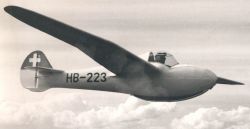
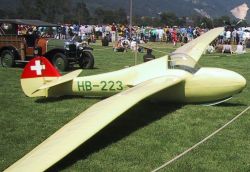
HB-223, H28-2: Manufacturer: by F. Ruprecht in Rheineck CH First flight October.1937, current owner Lilly-A. Grundbacher,
2007 not ready to fly, stationed in Thunstetten CH
HB-321, H28-2: Manufactured.in Rheineck CH First Flight 1937, 2007 not ready to fly, stationed in a hangar in Zimbabwe
D-15-944, H28-3: Nothing left but some photographs from the year 1939
OK-..., H28-2: Made in Czechoslovakia, destroyed 1939 in a flood of the Moldova
OY-DOX, H28-2: Manufacturer: Carl Johansen 1943 in Denmark, was approved for a Maximal speed (Vne) of 250 km / h; participated at the World Cup 1951, 2007 not ready to fly, stationed in the USA
D-8223, H-28II "Kurier": Manufacturer: Werner Kaluza, Warburg Years of construction: 1996 to 2002; first flight on 11 October 2003. Since then Werner was involved with his Hütter H-28II many Soaring Oldtimer meeting in Germany also in Italy. At many air shows throughout Germany was able to admire his beautiful glider D-8223. We hope that we may see this glider still some years in the air.
GB-HJM, H28-2: Manufactured in England in the year 2002, authorization was denied. Not airworthy in 2007.
Further pictures at www.wlm-modellbau.de/huetter28/original.htm
| Type | Hütter H-28 | Immatriculation | HB-223 | | Developpment | W. Hütter | Company of fabrication | F. Ruprecht in Rheineck CH | | First flight of the type | Okt. 1937 | Number ever built | 6 | | Year of fabrication | 1936 / 37 | Number of seats | 1 | | Wing span | 12.00 m | Length | 4,8 m | | Weight (empty) | 105 kg | Wing area | 8.5 m2 | | Wing profile | Gö 533, Gö 532 | Aspect ratio | | | Fuselage construction | Wood and plywood | Wing construction | wood | | Maximum speed | 170 km/h | | | | Best glide ratio | 28 | Minimum sinking speed | | | First owner | | Curriculum vitae | see below | | Today´s owner | Lilly-A. Grundbacher | Home airfield | | | Last revision | | Hours / Flights | 229 / 213 |
HB-223 was manufactured by Mr. F.Ruprecht in Rheineck, a community in the St. Gallen Rhine Valley, Switzerland. The final examination took place by the AeCS in Rheineck 3 October 1937.
1957 to 1959 Eugen Aeberli and Egon Polla took it along to visit various gliding camps, e.g.:
- On Easter, 20 April 1957 they went to Magadino in the south of Switzerland. Who doesn’t know the well-known pictures? The complete Hütter H28 fixed onto the roof of the car (VGC news No.107 winters 2002 P.11).
- 13 July 1937 they travelled to Samedan, with a K2 on a trailer behind their car, trailer coupling welded to the bumper (VGC news No. 108 spring 2003 P.17).
- 4 September 1958 visit to Mollis, 31 August 1959 to an airfield in a town named Bad Ragaz (= Bath Ragaz).
It was in the summer of 1957 when Egon was towed by Sepp Widmer and in a gust of wind hit the canopy with his head, thus jettisoning the hood. Sepp (= Joe) observed the dropping, Egon released the tow rope and steered the tug in a steep spiral to keep the canopy in sight. Sepp managed to describe the discovery site, a meadow, exactly. The canopy was found, damaged but with all instruments still attached. Egon subsequently modified the glider: The canopy height was increased by 4 cm and the instruments installed in front of the hood.
1957 to 1959 Egon logged altogether 25h 22 min on the HB-223, until he had to stop flying for vocational reasons.
According to entries in its log book HB-223 was used afterwards until 22 October 1965 by private and club pilots at Spreitenbach airfield.
Later Eugen allowed some of his apprentices to fly the HB-223 at Birrfeld airfield, e.g. 1965 Röbi (Robert Jetzer). After a cross-country flight Röbi landed in an orchard, thereby damaging the aircraft nose. Ruedi Sägesser had to repair the nose immediately. He did not have time to form the plywood parts perfectly. Since that time the nose is no longer as beautiful as before.
Some time later the glider was sold to Lausanne.
HB-223 was deleted from the Swiss Aircraft Registry 21 October 1970.
Reregistration took place 26 April 1972 with the "e;Old Timer Club Zurich"e; as owner. The club had only two members, namely Eugen Aeberli and Benno Luethi. They went to fetch the Hütter H28 in Lausanne where it was stored in a barn.
Eugen had flown the HB-223 often, e.g. at the VGC Meeting of Old Timer Gliders 1975 at Gruyères. A notable event took place at the beginning of June 1974 on the Wasserkuppe, where Eugen logged ten hours in six flights on the H28, which proved to be a great attraction.
After the last flights 1975 the aircraft had logged 213 flights and 229 flying hours. The last official inspection for its condition took place on 13 November 1976.
In 1986 the HB-223 was decommissioned.
Eugen sold the HB-223 1986 to Max Daetwyler, an industrialist based in the Oberaargau, an area in Switzerland. Max Daetwyler and Wolfgang Hütter had known each other since after the war, when Max had gone to Germany to tow gliders – motor flying was off limits to Germans for a few years after the war. The contact between the two was renewed in connection with preparations for the serial production of the MD3-160 Swiss Trainer, an airplane being developed by Daetwyler. As Max Daetwyler valued the experience of Wolfgang Hütter as an airplane constructing engineer, he had hired him as a consultant.
The H 28 was the first aircraft Wolfgang Hütter had constructed independently, and thus it became of particular importance emotionally to Max Daetwyler. Max had planned to establish an airplane museum, for which the Hütter 28 would be a suitable attraction. (After the death of Max Daetwyler in 2005 this long-term project is now in the hands of his son Peter). 1993 Max brought the HB-223 to the Friedrichshafen Aero Exhibition. Before that Ruedi Sägesser had been asked to do some emergency repairs, especially replacing parts of the wing fabric. The HB-223 made it for the exhibition, painted with clear paint only.
In April 2001 Max Daetwyler gave the HB-223 to Lilly A. Grundbacher. It was essential to Max that the Hütter 28 would be restored to flying condition, something Lilly had planned to do in the workshop of Ruedi Sägesser. Ruedi however sold his workshop in April 2004 and died less than a year after. Peter Daetwyler regretted that his old father had given away the glider lightly. Subsequently Peter and Lilly agreed that the glider would fall back to the Daetwyler family once she would no longer be holding a gliding licence. 2004 Lilly has bought a carpenter´s workshop in Grandfontaine, which is in the process of conversion to be suitable for aircraft restorations. Meanwhile the H 28 is mothballed and stays with Peter.
Examinations done by Werner Kaluza showed that in some places the glue is no longer firm. It is feared that the restoration will be more labour-consuming than originally assumed. However, Lilly is confident to master this problem as well; starting to work on the restoration of the H 28 is planned for 2009.
By Lilly A. Grundbacher at Grandfontaine, 28 November 2007
|


