Now at 2007, there are only 7 S-Kranich known, the most famous 3: HB-175 with fuselage (made of wood), built by the SG Olten, exists no more.
HB-517, Manufacturer not known, Owner is the SG Dittigen, fuselage with steel tube, 2007 ready for exhibition, grey, not airworthy
HB-330 , Manufacturer: Aeronautical technical training center - Belpmoos
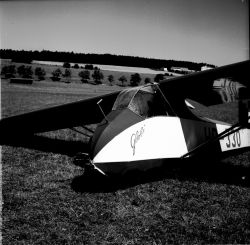 copyright by Urs Hünerwadel
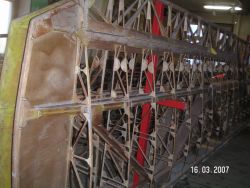
Further pictures at www.wlm-modellbau.de/spalinger/weitere.htm | Type | S-Kranich | Immatriculation | HB-330 | | Developpment | J.Spalinger | Company of fabrication | Aeronautical technical training center Belpmoos | | First flight of the type | 1933 at Olten | Number ever built | 7 | | year of fabrication | 1941 | Number of seats | 1 | | Wingspan | 11.00 m | Length | 6.25 m | | weight (empty) | 179 kg | Wing area | 16.5 m2 | | Wing profile | | Aspect ratio | | | fuselage construction | ab 1946
steel tube | Wing construction | Wood and plywood | | Maximum speed | 100 km/h | | | | Best glide ratio | 12 | Minimum sinking speed | | | First owner | Flight school Birrfeld | curriculum vitae | see below
| | Today´s owner | Lilly-A. Grundbacher | Home airfield | | | Last revision | | Hours / Flights | 229 / 213 |
Curriculum Vitae of the glider HB-330 "e;S-Kranich"e; (Crane), a.k.a. "e;Globi"e; 1935 the Gliding Club (SG) Olten built the first S-Kranich, HB-171, according to the plans of J. Spalinger, dated 1932. The fuselage was made of wood, with an open cockpit as was not unusual at the time –of which the "e;Zögling"e; is probably the most famous example. Spalinger justified this construction as follows: "Just as the „Zögling"e; was adapted to the classical Bungee launching method, winch launching gradually shaped our "S-Kranich".... A transition from the S-Kranich to any performance glider was achieved always successfully and in all cases without breaking anything...."
The glider HB-330 was built in 1941 by members of the "e; Flugtechnischen Ausbildungszentrale"e; (aeronautical technical training centre) at Belpmoos, the airport near Berne. The building process was monitored by examiner O. Schurter.
The first flight test, also by O. Schurter, revealed the craft to be tail-heavy.
The installation of 4 kg of lead into the aircraft nose resolved that problem.
A second flight examination by flight instructor M. Kramer showed a satisfactory result, after which the plane was found fit to be used by the flying school. On the 14th of August 1941, the glider was officially entered as HB-330 into the Luftamt-registry, the Birrfeld Gliding School being listed as both owner and operator. Between 1943 and 1945 ownership and operations were with the Brugg Gliding club (SG Brugg). In 1946 the wooden fuselage was replaced by one made out of steel-tubing. Mssrs. Nicolet and Weber of the Swiss Federal Aviation Authority (Luftamt) oversaw that change, M. Leder, a flight instructor, made the first flights. From 1946 to 1948 the Aargau section of the Swiss Aero Club owned and operated HB-330. Up to 1952 the glider logged 2659 landings and 87 hrs 30 mins of total flying time. 1952 it was restored and covered with new fabric. The aircraft was sold to the "e;Gliding Club Thermik of both Basel"e; in 1958. It was used for instruction purposes, first in Olten, from 1959 onwards on Porrentruy airfield. Later, when performance gliders made out of glass-reinforced plastic where bought, it was no longer a requirement for student pilots to solo on the S-Kranich. Therefore, no one wanted to fly it any more. Up to 1967, HB-330 has logged 2848 landings in total, with altogether 154 hrs and 31 mins of flying time. The entry "e;HB-330"e; was deleted from the Luftamt Aircraft Registry on February 27, 1968. Mr. B. Wettstein bought the glider in December 1994. It suffered from a flooding and subsequently Mr. W. Fahrni cut open the famous aircraft nose in order to get rid of the water that had intruded into it. On March 12, 2007 Ms. Lilly-A. Grundbacher took over the aircraft - bare hull and wings, less instruments and fabric. She stores it in her workshop at Grandfontaine and intends to restore it to flying condition.
_______________________________________________________________________________________
Email von Willi Schwarzenbach an Lilly Grundbacher am 9. Jan 2010
Die S-Kranicheinträge habe ich durchgesehen, sie stimmen.Der Oltener Kranich HB-171 wurde nach Hermann Rütschi wohl 1934/35 gebaut und war 8 Jahre lang im Gruppenbetrieb eingesetzt. Buch Rütschi "Segelflug" 1944 und "Jubiläumsschrift SG Olten" 1988. Im Aero-Almanach 1943, (Registerstand per 31.12. 1942) ist er nicht mehr aufgeführt und es kann angenommen werden dass er in jenem Jahr kaputt ging.Der Winterthurer HB-221 ist im Aero-Almanach 1937 (Stand 31.12.1936) eingetragen als "Spa-Opitz (im Bau)" und wurde in allen folgenden Ausgaben als S-Kranich bezeichnet. Wie weit Spalinger seine Konstruktion mit dem Opitz-Zögling kombiniert hat, weiss ich nicht. Tatsache ist, dass August Hug einen Opitz umkonstruiert hat und dass daraus der "Dreckspatz" entstand, dies im Rahmen der seinerzeitigen Gruppe Ikatus in Zürich. Der Opitz war sowieso ein etwas fragwürdiger Drachen und war von zu Hause aus viel zu schwanzlastig. Darüber habe ich einige Unterlagen.
Mit Gruss
Willi
_______________________________________________________________________________________
Auszug aus Brief vom 13.12.1982 von Jakob Spalinger an Herman Rütschi.
Frage: wurde aus dem OPITZ ein S-Kranich?
...Ich habe mich überlegt, wie begann es eigentlich mit der Segelfluggruppe Mittelland für mich. Ich erinnere mich, dass ich mich eines Tages auf den Weg zu euch (in Olten) machte, irgendwo von einem Motorfahrer abgeholt und auf den Brunnersberg gebracht wurde. Leider kam ich zu spät. Der "Opitz" war wenige Minuten zuvor zum Bruch gegangen. Leitwerkträger und Sitzteil waren zerstört. Flügel und Leitwerk sahen noch brauchbar aus. Du hast mir dann die Rolle des Helfers zugewiesen.
Als erstes ging ich in eine Buchhandlung und entstand mir den Band 107 der Sammlung "Spiel und Arbeit" von E. Opitz. Ich versuchte dann auf dem Papier einen vernünftigen Kompromiss zu den vorhandenen Flügeln und Leitwerk zu finden. Du hast es dann mit deinen Helfern gebaut und geflogen. Irgendwann wurde dann ein Flügel stark beschädigt. Man entschloss sich, auf die 12 m Flügel zu verzichten > neue 11 m Flügel und ein besseres Leitwerk zu bauen. So wurde aus dem "Opitz" der "Kranich". Aber zu jener Zeit war ich dann schon öfters in Olten anzutreffen.
Gewiss wäre es möglich, anhand der alten Briefe, die zwischen uns gewechselt wurden, die Geschichte zu rekonstruieren. Aber ich vermute, dass das niemanden mehr interessiert.......
|


